
To download our magazine for free, fill in the form below.
Introducing Ocean Remediation
The vastness of our oceans can be difficult to fathom. It is perhaps partly for this reason that the consequences of damage we inflict on them seem intangible, unrelatable, and distant. The ocean’s climate challenges can be tricky to communicate – rising sea levels are a slow burn compared to wildfires. In some cases, the ghosts of our past (mis)treatment of the ocean are coming back to haunt us.
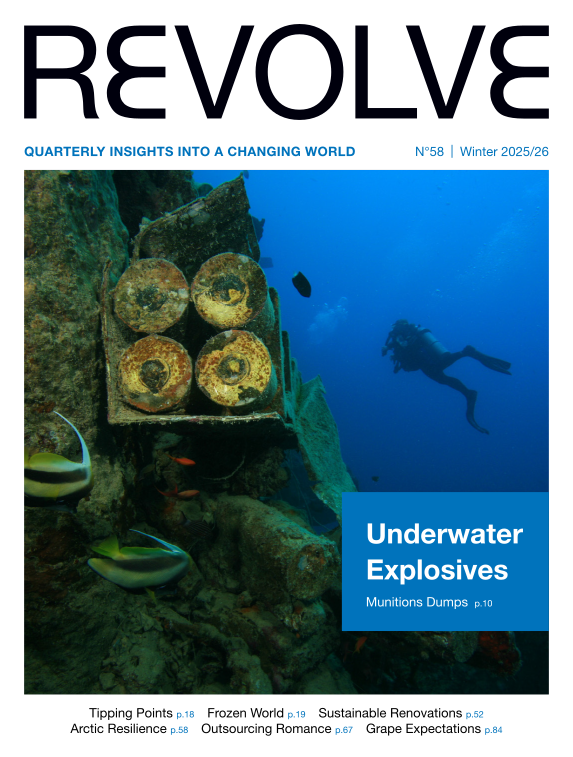
Over 1.5 million tonnes of unexploded munitions lie at the bottom of the North and Baltic Seas, a dangerous hangover from the World Wars. Cast into the abyss and forgotten about for years, these ordnance dumps have become a growing problem in Europe and beyond. They hinder marine development projects and slowly release dangerous chemicals into underwater ecosystems, a process that is accelerating as our oceans warm.
Our oceans absorb excess heat and emissions from human activity in staggering quantities. Take a peek at any reliable chart and you will see that ocean temperatures have been steadily climbing each year, almost without fail, since the 1990s. The effects of this warming are starting to accelerate. Coral reefs are on the cusp of widescale decline, polar ice sheets, and glaciers are in retreat, and weather systems are becoming less predictable and more intense.
In her Guest Editorial, international environmental and ocean lawyer and IPOS co-lead Tanya Brodie Rudolph calls for new models of ocean governance that marry scientific knowledge with policy and community action.
Then, we head below the waves as Ahmetcan Uzlaşik navigates the risks and repercussions of dumping munitions in the sea – who should clean it up, and how? Renowned climatologist James Hansen shares his thoughts on whether we can avoid more climate tipping points before our first VIEWS takes us to the frozen corners of our world with a tour of the cryosphere.
We stay with that topic in our next feature from Samrat Deb, who tells us about Trans-Himalayan peatlands. Over to Catalonia next, where Nicolás Marín takes a look at a brand-new project on circular water in agriculture. Next, Anna Nazario spotlights efforts to make our building stock more energy efficient before Lauren Beauchamp travels to Finland to learn about community resilience.
Our second VIEWS looks at the social implications of outsourcing Europe’s floriculture industry before Tom Lovett uncorks the secrets of extracting biofuel from Spanish wineries. Then, it’s over to Asya Al Marhubi for some circular architecture and Hollie Fisher for some culture.
Enjoy reading REVOLVE and send us your comments at:

Jake Threadgould
Editor-in-Chief
Inside this issue
Editorial
Tipping Points and Lifelines: The Future of Our Ocean – Toward better ocean governance
Features
The Sea’s Forgotten Arsenal – Clearing dumped munitions
Mapping the Way to Water Security in the Trans-Himalayan Peatlands – Resource security in the mountains
Testing the Waters – Circular water solutions in farming
Retrofitting Europe’s Buildings – Boosting building efficiency
Adapting at the Edge of Northern Lapland – Climate action from northern Finland
Bubbles to Biofuel: Decarbonising Road Transport – Turning wine into fuel
Circularity and the Redefinition of Beauty in the Built Environment – A changing mindset
VIEWS
The Price of Roses – Europe’s flower industry moves abroad
The Cryosphere: Earth’s Frozen Shield – The frozen reaches of our planet play a vital role in climate stability
Interview
Beyond the Point of No Return – James Hansen’s warning
Between
Reclaiming Patriotism for Climate Action – Where politics & climate clash