
How Data Powers India’s Shift to Electric Freight
E-trucks are decarbonising India’s transport sector, with data driving efficiency, planning and scale.
India is witnessing historic growth. Rapid urbanisation, a rising population, expanding e-commerce, and higher incomes are dramatically increasing the demand for goods and services. To keep pace, the road freight sector is projected to grow nearly fourfold by 2050, according to research published in 2022 by The National Institution for Transforming India (NITI Aayog), a government think tank. However, if this surge continues to run on fossil fuels, it will worsen air pollution, deepen public health crises, inflate energy costs, and drive up emissions just as we race to reduce them. Meeting future freight demand with conventional diesel trucks would mean spending over US $1 trillion on crude oil imports by 2050 reports NITI Aayog, an unsustainable economic and environmental burden.

Already responsible for 70% of goods movement and nearly 40% of fuel use, India’s road freight sector stands at a pivotal moment. The transition to Zero-Emission Trucks (ZETs) offers a clear path to decarbonisation, cutting emissions while lowering operating costs and achieving India’s net-zero goals. With battery costs falling and policy momentum accelerating, the missing link isn’t technology but data. By leveraging e-freight data to accelerate adoption and debunk technology myths, India can unlock the economic, environmental, and health benefits of zero-emission trucking.
Road freight drives the Indian economy
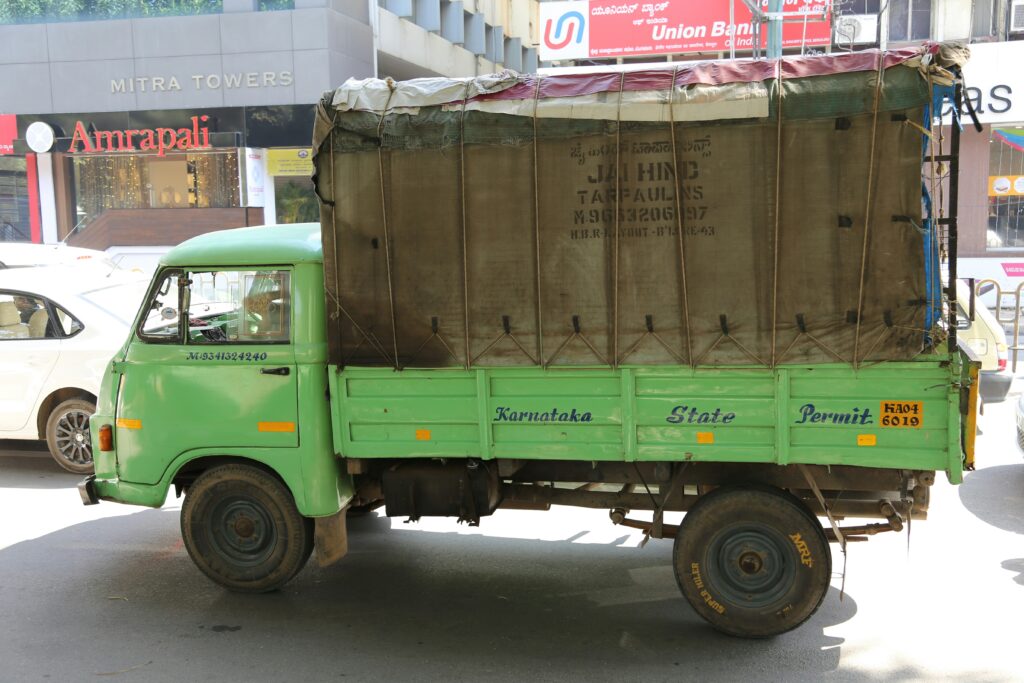
India’s freight network is the backbone of its economy and one of its biggest climate challenges. A working paper by the World Bank published in 2018 found that the country moves about 4.6 billion tonnes of freight each year, creating a transport demand of 2.2 trillion tonne-kilometres at a cost of nearly $115 billion. Trucks dominate this movement carrying over 70% of domestic freight while representing less than 5% of total vehicles.
India moves about 4.6 billion tonnes of freight each year, creating a transport demand of 2.2 trillion tonne-kilometres at a cost of nearly $115 billion.
However, freight trucks are responsible for a disproportionately large share of India’s transport emissions. They account for nearly 40% of on-road fuel consumption and roughly half the particulate and NOₓ pollution. Transport analysts estimate that under business-as-usual, the number of medium- and heavy-duty trucks on our roads will more than quadruple by 2050. Transport already makes up 13% of India’s total energy-related greenhouse gas emissions, according to India’s fourth biennial update to the UNFCCC. If current trends continue, India’s truck fleet could quadruple by 2050 locking the country into higher emissions, fuel imports, and health costs.
Why electrify and why now?
The case for ZETs is no longer environmental idealism; it’s economic pragmatism. According to NITI Aayog, wide-scale Zero- Emission Trucks adoption could help India avoid 3.8 gigatonnes of CO₂ and save about US $140 billion in oil imports by 2050.
The public health case is even stronger. Studies from IIT Kanpur and the International Council on Clean Transportation (ICCT) estimate that accelerated EV adoption could prevent more than 70,000 premature deaths each year by 2040. Communities in freight corridors often already live with asthma, respiratory distress, and constrained daily lives because of dust, smoke, and pollution. Clean-air benefits would be immediate and meaningful.
And yet, electrified freight remains a rounding error in India’s logistics sector. Of over 0.83 million trucks sold in 2024, just 6,200 were electric and 95% were small urban vehicles. Only 280 were heavy-duty electric trucks. This gap isn’t for lack of will; it’s for lack of data. Without reliable, shared information on routes, costs, usage, and demand, no business model can scale.
Building the policy momentum, India is already steering in the right direction with the government having announced US $60.2 million in incentives for over 5,600 e-trucks, and subsidies of up to USD 57 per kWh. The Bharat Zero Emission Trucking (ZET) policy advisory, led by the Office of the Principal Scientific Adviser, calls for tax breaks, low-interest loans, and charging infrastructure along key corridors. Guidelines released by the Union Government recommend fast chargers every 100 km on national highways. And the National Logistics Policy and Unified Logistics Interface Platform are aligning multiple agencies behind a common digital backbone.
Meanwhile, NITI Aayog’s e-FAST initiative has aggregated demand commitments for nearly 7,800 ZETs from 16 companies creating a pathway for scaled manufacturing and adoption. Policy frameworks are already aligning with the government identifying ten highway segments for zero-emission truck movement showcasing that the political will exists. These efforts show strong intent. But turning pilot projects into national transformation depends on one missing ingredient: data-driven adoption of electric freight in India.
C40 Cities’ Laneshift Programme has begun to show how data can bring this hope within reach. Along the 350-kilometre Bengaluru-Chennai highway, Laneshift is testing long-range electric freight trucks. Early operational data indicate that with sufficient infrastructure and planning, fuel cost savings and emission reductions are large enough to make electric trucks viable for real commercial freight, not just pilots.
Truck manufacturers, logistics firms, state governments, and EV infrastructure providers are now collaborating, learning where charging must be placed, understanding where trucks break down or idle, and where demand patterns make or break profitability. Businesses, cities and finance are coming together to accelerate the positive tipping point for zero-emission freight, making the technology more affordable, accessible, and attractive than conventional fossil fuel alternatives showcasing the use of data for building momentum in the industry.
The Indian government has announced US $60.2 million in incentives for over 5,600 e-trucks, and subsidies of up to USD 57 per kWh.
Fleet, charging, route, energy, freight, and policy data are key to driving India’s e-freight adoption and operational efficiency. Financing can be structured to favour operators with smaller fleets who today are excluded because the risk is uncertain. And communities living near major freight routes – often poorer or marginalised – can benefit first, because emissions reductions will happen where emissions are worst. Cities can also play a role by utilising ‘pull’ policies to foster market momentum. For electric trucks, this includes leading by example by mandating the electrification of municipal vehicle fleets to generate early demand and build initial charging infrastructure. This initial phase is crucial, as it builds public support before cities introduce ‘push’ policies. These regulatory measures, such as implementing Low Emission Zones (LEZs) or establishing mandates that limit fossil fuel vehicles, make conventional ICE trucks less convenient or unavailable, accelerating the market shift away from old technologies.
With freight electrification, there are broader gains beyond health. Reducing India’s reliance on imported diesel strengthens energy security. Lower fuel and maintenance costs will bring down costs of goods, helping low-income communities. Green jobs in charging infrastructure, battery servicing, and EV manufacturing can revive regional economies. While cleaner streets and quieter nights are the improvements people will directly feel.
How can data drive e-truck adoption?
E-trucks are crucial for India’s freight decarbonisation, with data playing a pivotal role in accelerating their adoption. Data, including telematics, operational, and charging information, is vital to speed up their adoption. This data helps to understand battery usage, energy efficiency, and route performance, which is essential for replacing diesel trucks. Charging data further guides the strategic placement of charging stations and maintenance hubs, plan for energy and grid infrastructure enabling efficient nationwide deployment.
Using data on freight movement to see where goods move, where demand centres are, and where routes overlap can help match the right type of electric truck to the right route and duty cycle. It also enables charging stations to be planned where they are actually needed.
Demonstrating these data-driven efficiency gains not only debunks technology myths but also encourages private sector participation and scales e-freight adoption beyond pilot projects. This evidence-based data driven approach to electric freight adoption in India contributes to policy making, enables targeted investments, maximises environmental benefits, and accelerates large-scale adoption of zero-emission freight.
When aggregated responsibly, these insights can also help policymakers and utilities anticipate charging demand, optimise grid planning, and prioritise investments in high-impact corridors.
The accelerating transition to electric freight
This is an opportune movement for the transition. Battery costs have dropped substantially. Grid technology is improving. Policy frameworks are aligning as the government shows commitment to a future of electric freight.
When data is leveraged it can power smarter decisions across the ecosystem. Policymakers can plan infrastructure where it’s needed most. Financiers can price risk accurately, enabling credit access for small fleet operators, the main drivers of India’s road freight. OEMs can optimise for real-world Indian routes, and cities can target emission reduction where the air is dirtiest.
We need to treat data not as an optional add-on but as an enabler for stakeholder decision-making in India’s EV transition. Data-driven e-truck adoption is key to achieving India’s net-zero goals enabling a cleaner, smarter, and more efficient freight future in India.


Join Planet
REVOLVE today
We strive to communicate sustainability for a better world for the next generations.
Support us by becoming a member of REVOLVE Planet today.
Become a Member