
Why Local Voices Matter in the Arctic
Europe must move from symbolic Arctic strategies to real partnerships that respect communities and balance climate ambition.
Europe often speaks of the Arctic as a frontier of geopolitical tension, climate urgency, and economic opportunity. Yet what emerged clearly at this year’s Arctic Futures Symposium is that the region is still treated as distant and remote rather than a living political space whose communities bear the immediate consequences of global choices. It is a region where climate impacts emerge earlier, where global competition intensifies, and where communities are asking Europe not for declarations, but for responsibility.
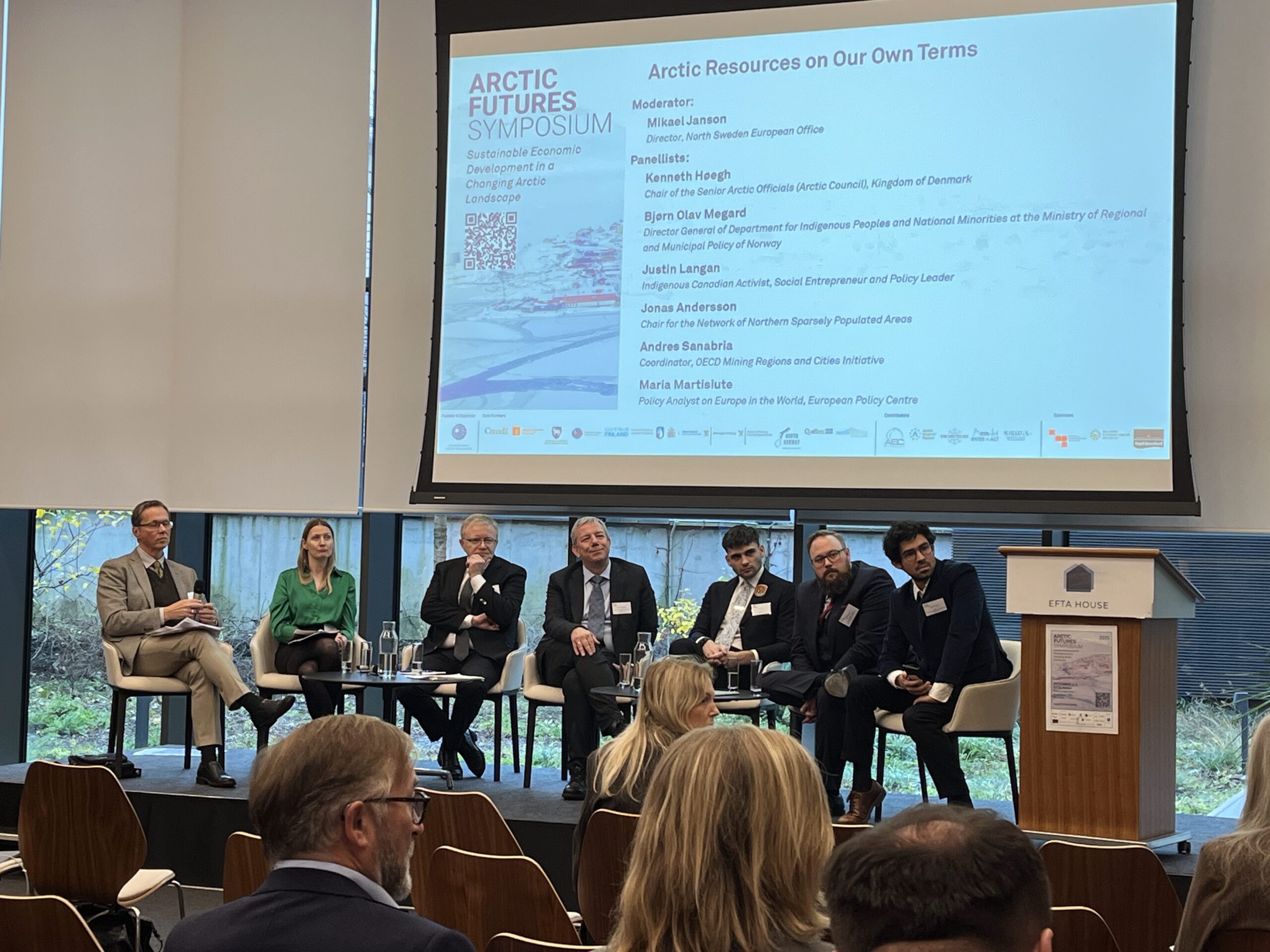
A session titled “Arctic Resources on Our Own Terms” offered a stark reminder: the Arctic is not an empty expanse on a map — it is home to nearly four million people. Its future cannot be engineered solely through Brussels, Washington, or Oslo. It must be co-created with, not for, those who inhabit it.
A region shaped by global competition
Speakers described how the Arctic increasingly mirrors broader geopolitical tensions. China’s growing Arctic footprint, Russia’s military posture, and rising interest in mineral extraction all highlight a region under pressure. The Arctic is no longer a quiet periphery – it is a strategic crossroads.
Europe tries to position itself as a climate leader through sustainability commitments and science-based policy. But ambition alone is not enough. Several experts warned against the EU using the Arctic as a stage to project environmental virtue without addressing contradictions within its own policies. To be credible, Europe must apply consistent standards at home and abroad and acknowledge the trade-offs that accompany industrial, environmental, and security interests.
This disconnect reflects a deeper issue: Arctic communities rarely exercise real decision-making power, even on policies that reshape their economies and ecosystems. Local leaders repeatedly highlighted the frustration of being “consulted” but not genuinely heard. As Canadian Indigenous activist Justin Langan put it: “People want to be heard — it’s how they’re heard that’s crucial.”
Arctic communities rarely exercise real decision-making power, even on policies that reshape their economies and ecosystems.
Building trust through local capacity
A recurring theme was that Europe could learn from Canada’s shift toward Impact Benefit Agreements (IBAs), which require companies and governments to negotiate directly with Indigenous communities before any project proceeds. While IBAs are not perfect, they meaningfully shift power and ensure that benefits, protections, and priorities are defined locally rather than imposed externally. By contrast, many European Arctic states still treat Indigenous participation as symbolic rather than structural.
This matters even more as new strategic sectors emerge. Minerals needed for Europe’s green transition such as nickel, cobalt, rare earths are increasingly located on Indigenous lands. Without governance rooted in consent, partnership, and long-term community capacity, Europe risks reproducing the extractive mistakes it now criticizes elsewhere.
The historical weight of these mistakes lingers. As Swedish statesman Axel Oxenstierna wrote in the 17th century, “I do not need a colony, I have Norrland.” The quote resurfaced at the symposium as a stark reminder that extractive logics, justified for centuries through colonial thinking — still shape relationships between capitals and peripheries. Today’s policies must actively break from that legacy.
Communities want partnership, not protectionism
Indigenous and Arctic community representatives challenged the way policies are too often designed about them instead of with them. Europe’s well-intentioned environmental objectives can sometimes translate into paternalistic approaches that overlook local realities or constrain economic opportunity.
Community leaders emphasised the need for meaningful participation, long-term investment, and economic pathways that allow young people to stay in the region. Their message was clear: Arctic communities do not seek to be shielded from the outside world. They want to shape their future on equal footing.
Arctic communities do not seek to be shielded from the outside world.
This point resonated particularly strongly in discussions about Greenland. As a self-governing part of the Kingdom of Denmark, Greenland owns and manages its natural resources — a cornerstone of autonomy forged through a long process of reclaiming agency after a colonial past. As Kenneth Høegh, Chair of the Senior Arctic Officials of the Arctic Council (2025–27), underscored: “It’s all about securing local benefits.” For Greenland, resource ownership has enabled decisions that reflect social values, community priorities, and political self-confidence.
Several participants argued that Greenland’s model is one that other Arctic regions could learn from when reconciling historical grievances with present-day development pressures. While no governance system is flawless, Greenland demonstrates how local ownership can help repair trust and anchor sustainable decision-making. Europe’s policies should respect and reinforce this approach — not override it.
Energy transition must start with people
Clean energy opportunities are expanding across the Arctic, from wind and hydrogen to small-scale grid innovations. But technology is not the barrier — governance is.
Speakers reflected on the challenge of bringing large-scale energy projects into remote regions where infrastructure is limited and land carries cultural significance. A sustainable energy transition in the Arctic must therefore prioritise community ownership, long-term funding, and designs that reflect local needs before export ambitions.
Europe has an opportunity to support Arctic partners in developing resilient, low-carbon energy systems. But success will depend on whether the EU listens to concerns around land use, ecosystem disruption, and the pace and scale of project development.
Europe’s responsibility is not optional
The Arctic is changing faster than policy frameworks can adapt. Europe’s values of cooperation, sustainability, justice still matter deeply in the region, but they must be backed by actions that communities feel on the ground.
The symposium made one thing clear: Arctic communities want engagement, not abstraction. The question is whether Europe can shift from symbolic strategies to shared stewardship. For the sake of climate stability, geopolitical credibility, and community resilience, it must.