
Energy Efficient Cultural Heritage for All
The Museum of Work in Barcelona is set to be a local attraction and global reference for integrating full energy efficiency into renovated heritage buildings.
In Barcelona’s north-eastern neighbourhood of Sant Andreu, there is an old thread factory that includes many brick buildings. Like any other factory, these buildings include the remnants of a cylinder brick chimney that was powered by a central heating system. Today, the mini ‘district heating system’ is defunct, sitting inside one of these buildings behind glass windows. Now, the other buildings are used for other activities: there is a primary school and social club, and in spring 2026, the Museum of Work will open.
The Fabra i Coats compound had its glory days a century ago. A Scottish company called ‘Coats’ set up a thread mill in Borgunyà, north of Barcelona, near the Llobregat river, from which they used small hydro to make thread. Their operations moved and merged with Fabra – a leading political family of Catalonia at the time – and brought employment to women and children who were more agile and nimble with the threads. In the factory today, there is an exhibition of old artifacts and pictures from those times, that were not so long ago:
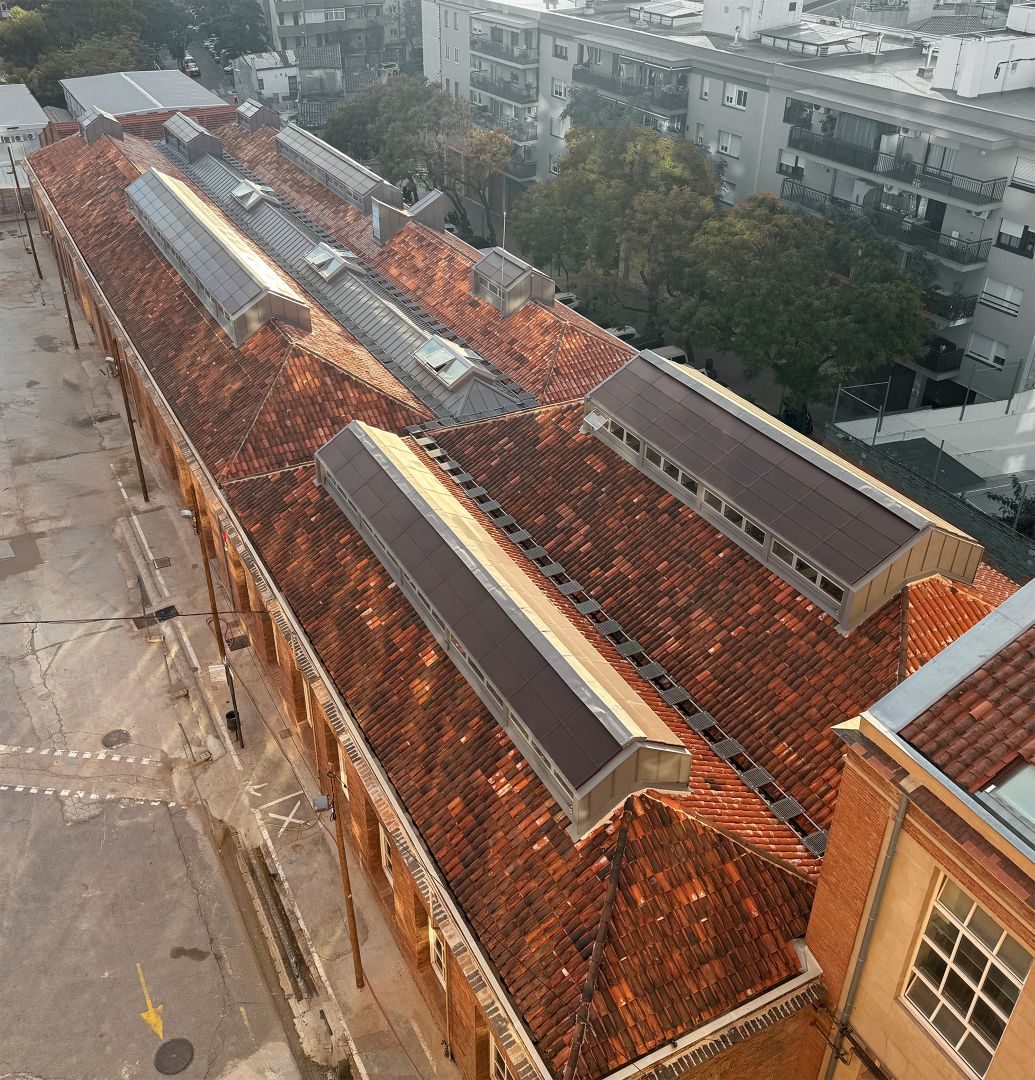
Commissioned by the Ayuntament (Institute of Culture – ICUB) of Barcelona in 2018, the renovation of the warehouse into a museum was completed in 2025. And all the tricks and tips for full energy efficiency were applied. This is a grade A building now – that’s the highest energy efficiency of the PEB ranking. “This is the first building in the Iberian Peninsula to install a special kind of Building-Integrated Photovoltaic (BIPV) called Solar Terra that is designed to be integrated in red ceramic pitched roofs,” says Gemma Serch from Tamayo-Valls-MATTERS, who confirms roundly that: “cultural buildings can be energy efficient.”
“Renovation is the biggest energy efficiency operation out there”, says Sander Laudy, architect at B01 arquitectes and member of the directive board of Green Building Council España (GBCE). Making new buildings efficient is easy, but older buildings can also be fully energy efficient. “As a matter of fact, they were so from the beginning, as they were designed to create comfort in a moment when climate-installations did not yet exist. People were less demanding then, true… but you can get far by using passive strategies, such as the ones applied by Matters, Valls, and Tamayo in this project. We should obviously minimise new construction in favor of reusing existing buildings for renewing urban areas. The real CO2 savings are to be found in avoiding making new buildings when there are still empty buildings that can be reused.”
Here, the space is 1,800 square meters: the windows were improved with full insulation, the windows in the roof above can open for ventilation in the summer to control the humidity and these windows have an ultraviolet filter that impedes the sunrays from bleaching the old machines, pianos, cupboards, typewriters, desks, and wood below.
Between the original wooden beams, thin cork panels were inserted to lightly insulate the roof and to counter asbestos that tends to creep into old buildings. The energy system in the basement provides 35% of the acclimatisation for the buildings, and the other 65% is passive energy savings.
But like the energy transition everywhere, there were unexpected complications. In reusing materials to match the circular economy criteria of reuse over waste, there were 8,000 terracotta tiles that were broken or missing and a bunch of bricks that were also missing. The renovators had to be resourceful and contacted the original providers and other similar sites with the same materials. “You need to be flexible when renovating buildings,” says Gemma Serch, “you can’t stick to the script 100%. There are always creative solutions.”
The Museum of Work will welcome school children to do workshops and will host a permanent exhibition of artifacts from other factories too. Barcelona has a large network of historical museums, and this one stands out for having provided work to women for decades. Integrated into the social fabric of the neighbourhood, the Museo del Treball, or Museum of Work, is a prime and proud example of merging cultural and industrial heritage for all.
BIMSA (Barcelona d’Infraestructures Municipals, SA) is the Barcelona City Council institution that operates all facilites works and was the operator of Fabra i Coats’ Building F project. Dani Alsina, Director of Innovation at BIMSA, says that “we are firmly committed to circularity and decarbonisation of our works. Therefore we foster the reuse of existing materials and the use of innovative materials that help to decarbonise our buildings and public spaces. We are developing internal protocols to embed these principles across all our projects available in the coming months.”